Ibn al-Haytham
A scholar whose studies of light brought observation, geometry, and experiment into conversation.
History Geeks contributor
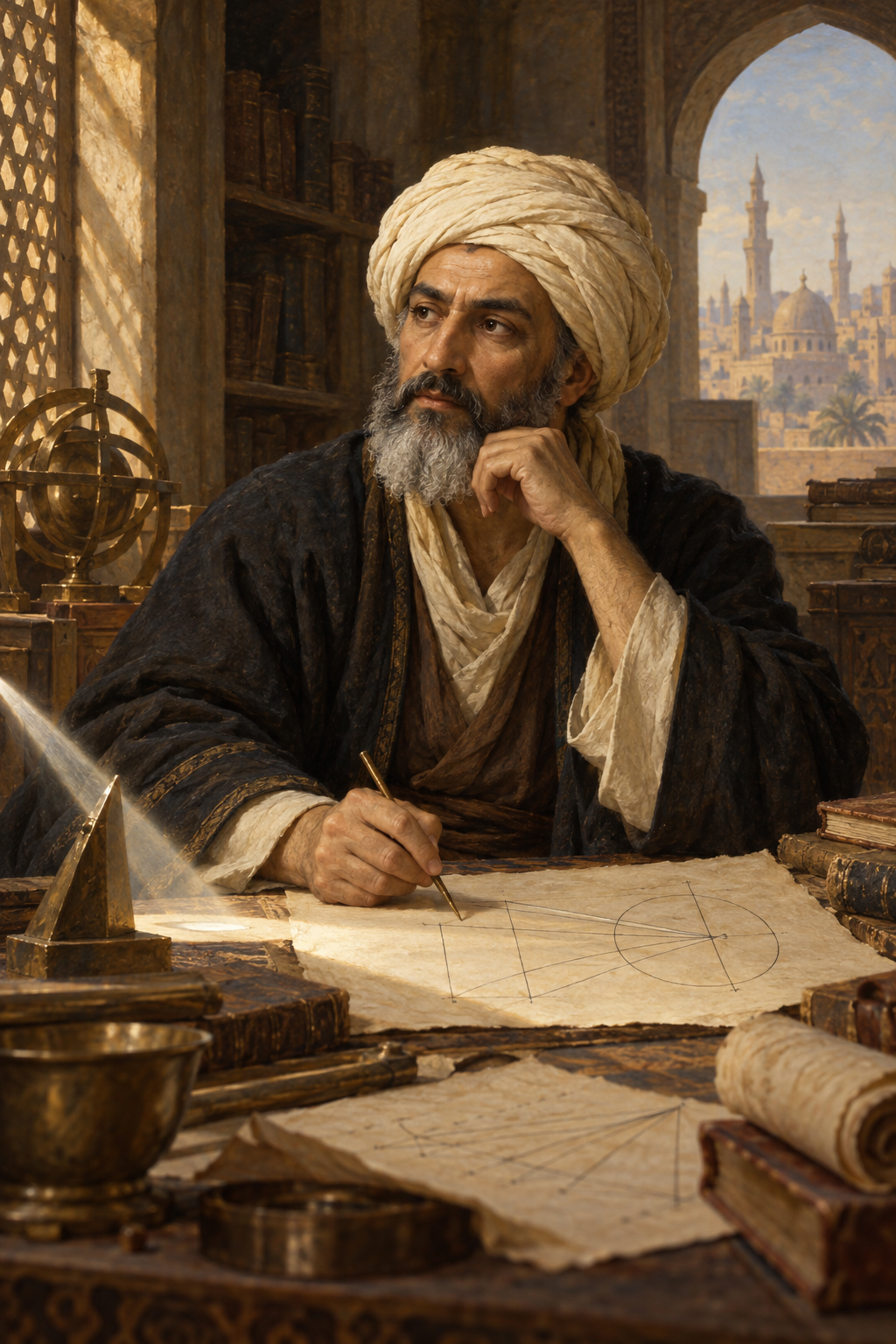
Contemporary artistic interpretation.
Overview
Ibn al-Haytham, known in Latin as Alhazen, was born in Basra and worked in Egypt. His writings addressed optics, mathematics, and astronomy during a period of extensive scientific scholarship in the Islamic world.
His Book of Optics examined how light and vision work. He combined mathematical reasoning with observations and experiments, helping to explain vision through light entering the eye.
His writings later circulated in Latin and influenced subsequent studies of optics. Calling him the sole inventor of scientific method would flatten a long, shared history, but his approach remains an important part of it.
Achievements and contributions
His investigations connected the geometry of light with the physical conditions of seeing. They helped establish optics as a subject in which a proposed explanation could be checked against a carefully arranged observation.
Ideas and historical context
A convincing account needed both reasoning and examination of the world. His scholarship offers a useful example of how inherited arguments can be respected without being accepted uncritically.
What we can take from the record
His work encourages patience with evidence and attention to the conditions of an experiment. Its later reception also reminds us that knowledge develops through translation, teaching, criticism, and exchange across societies.