Ada Lovelace
A mathematician who considered what a calculating machine might do beyond arithmetic.
History Geeks contributor
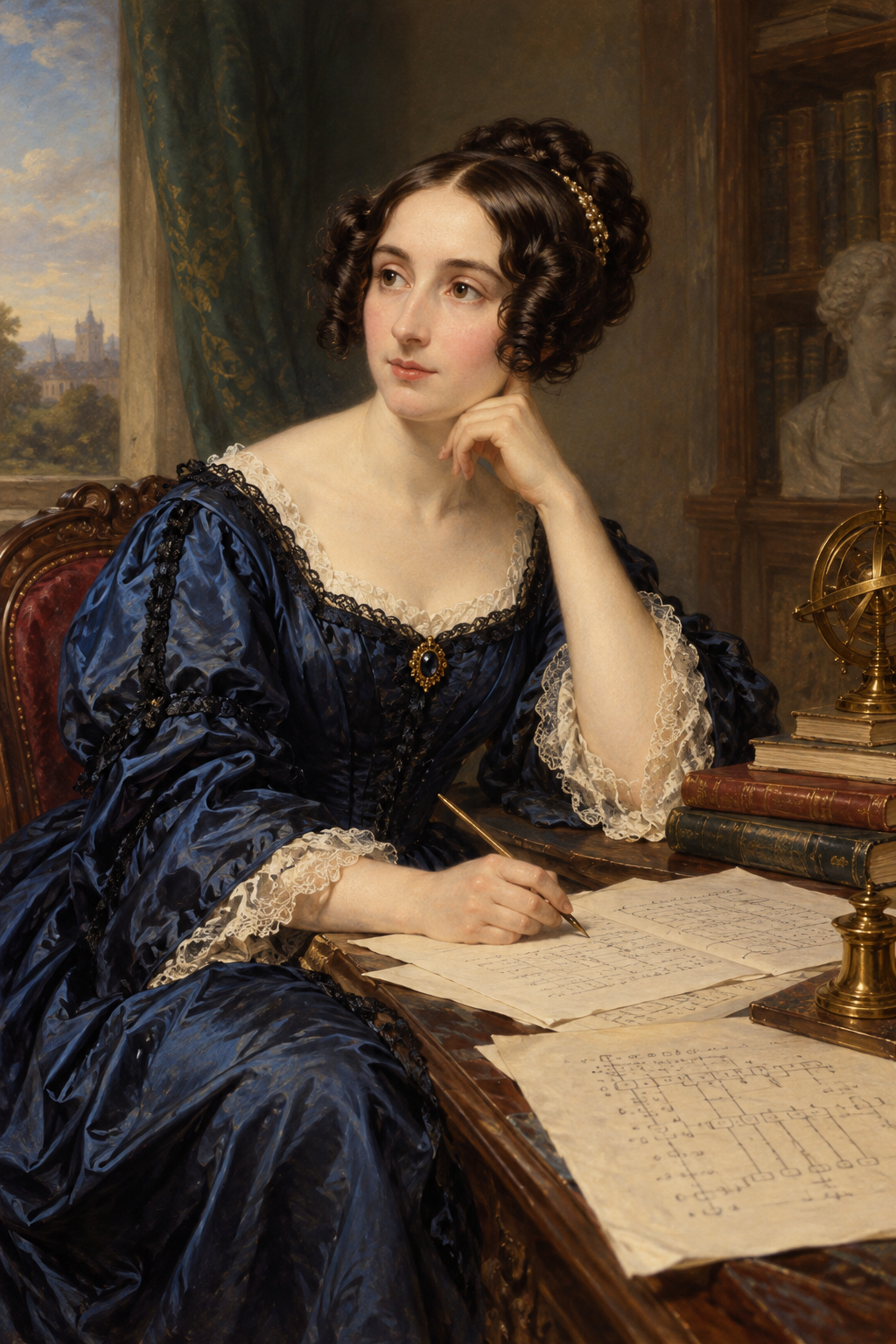
Contemporary artistic interpretation.
Overview
Ada Lovelace studied mathematics in nineteenth-century Britain, when women had limited access to formal scientific education. Her work is closely associated with Charles Babbage and his proposed Analytical Engine.
In 1843 she published a translation of an account of the machine, accompanied by extensive notes. Those notes included a procedure for calculating Bernoulli numbers and explored the possibility of processing symbols according to rules.
The engine was not completed in their lifetimes. Her significance lies in the surviving work and the questions it raised, rather than in claims that she anticipated every feature of modern computing.
Achievements and contributions
Her notes explained a complex proposed machine to readers and developed a worked mathematical example. They are an important record of early thinking about general-purpose computation.
Ideas and historical context
Lovelace connected mathematical analysis with imagination. She considered how a machine might operate on relationships beyond numerical quantities, while also distinguishing its operations from independent invention.
What we can take from the record
Her story shows the value of explaining a technology before its uses are settled. It also benefits from attention to collaboration and to the educational conditions that shaped who could participate in science.
Sources and further reading
Science Museum Group, Ada Lovelace